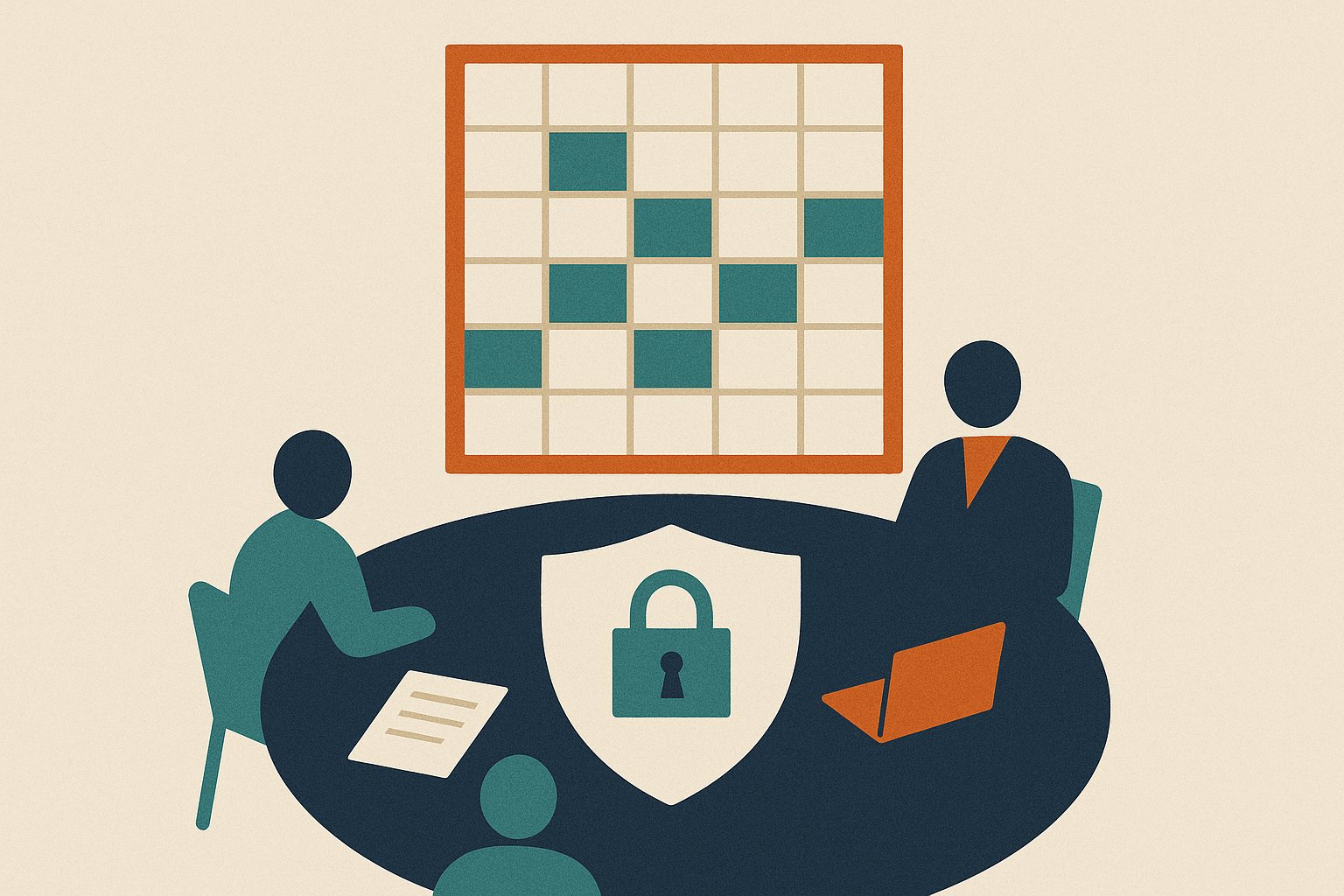
A cybersecurity tabletop exercise is a guided, discussion-based rehearsal of a security incident. A team works through a realistic scenario, makes the decisions it would make in a real event, and finds the gaps in its plan before an attacker does. There is no live network and no real attack. There are real decisions, real disagreements, and a record of what worked.
This guide explains what a tabletop is, why it has moved from optional to expected, and what separates an exercise that changes behavior from one that does not.
Why tabletops matter now
For years a tabletop was a nice-to-have. That has changed, and the change is now written into regulation. In New York, the amended cybersecurity rule at 23 NYCRR Part 500 requires covered financial entities to test their incident-response and business-continuity plans at least annually, and to do so with all staff and management critical to the response. Its final requirements took effect on November 1, 2025. An IT-only walkthrough does not satisfy that standard, and the rule pairs the testing obligation with fast reporting duties, including notification to the regulator within 72 hours of a reportable event and within 24 hours of an extortion payment, plus an annual compliance certification signed by the CISO and the most senior executive.
Public companies face a parallel expectation from the Securities and Exchange Commission. Under rules adopted in July 2023, a registrant must disclose a material cybersecurity incident within four business days of determining that it is material, and must describe, on an annual basis, how management and the board oversee cyber risk. A four-business-day clock rewards organizations that have practiced the materiality decision and punishes those meeting it for the first time under pressure. Federal critical-infrastructure reporting under CIRCIA points in the same direction. Cyber insurers have moved as well, increasingly asking for proof of a tested incident-response plan before writing or renewing a policy.
A tabletop tests the part of a program that tools cannot. Breach-and-attack simulation and penetration testing verify whether controls work. A tabletop verifies whether people make sound decisions under pressure. Both matter. Only one of them reveals whether the general counsel and the CISO agree on when to notify.
What a strong exercise looks like
The mechanics are simple. The discipline is not.
A specific scenario. "Ransomware hits the company" is too vague to force a decision. A named, plausible scenario tied to the environment is what makes participants act. Common starting points are ransomware, business email compromise, insider threat, and vendor or supply-chain compromise.
The right room. An incident is a business event. The room should hold security, IT, legal, communications, a business owner, and an executive who can authorize money and downtime. Each participant makes independent calls.
Timed injects. The scenario advances in steps that raise the stakes: detection, scope, the ransom demand, data theft, recovery, disclosure. Each inject exists to force a decision and surface a disagreement.
A facilitator who steers. A capable facilitator keeps time, presses past easy answers, and does not let the room agree its way out of hard choices.
A record at the end. An exercise is worth running only when it produces an after-action report, a posture score, and a set of findings with owners and due dates. A gap with no owner is a gap that returns the following year.
Scoring against a framework
Findings carry more weight when they map to a framework a board and its regulators already recognize. The NIST Cybersecurity Framework, updated to version 2.0 in February 2024 in its first significant revision since 2014, organizes security work into functions. The familiar five are Identify, Protect, Detect, Respond, and Recover. Version 2.0 added a sixth, Govern, and that addition matters for exercise reporting. The Govern function places cybersecurity risk under leadership and board accountability, and states plainly that organizational leadership is responsible and accountable for cybersecurity risk.
Scoring an exercise against those functions converts a vague impression into a defensible statement: the Respond function is weak, here is the evidence, and here is the plan. That is a sentence a board can act on, and it is the sentence a regulator or insurer wants to see documented. For an organization building from nothing, CISA publishes free tabletop exercise packages. They are a reasonable place to begin. They are documents, not a program. The value compounds when exercises run on a schedule, findings are tracked to closure, and the record is preserved.
The exercise as a defensible record
There is a further reason to run tabletops with care. The record an exercise produces can help an organization or harm it. A candid exercise names real weaknesses, and that candor is what makes it useful. It also creates a document that a plaintiff or a regulator might later seek. How the exercise is structured determines whether that record stays confidential, a subject addressed in privilege and tabletop exercises.
From an event to a program
A tabletop run once a year from a slide deck is better than nothing, and under the current rules it may not even meet the minimum. A tabletop run live, scored against the NIST framework, and converted into a tracked set of corrective actions is a program. The distinction between the two is the difference between an organization that can describe its readiness and one that can prove it.